

 Русский
 Español
 Português
 Українська
 Polski
 Türkçe
 Română
 اردو
اردو
 Italiano
S88 · Common reference page
Server 88 Documents
The goal is to protect peace and server growth without turning today’s ranking—or yesterday’s contribution—into permanent control. This page keeps the useful links together and separates agreed principles from questions that still need a vote.
Useful links
Main rules · proposed text
Proposed Server 88 Charter
This draft balances equal representation, technical reliability and recognition of real contribution. It deliberately gives no named alliance a permanent privilege, because rankings and leadership change.
Separation of powers and decisions
Authority is divided among three branches.
The Top-10 Council is legislative: each alliance has one equal vote and the Council adopts server rules. The Top-3 Operations Council is executive: it coordinates urgent operations and implements adopted decisions, but cannot make permanent rules or judge disputes.
Both memberships are fixed for each five-week cycle, so a few days of ranking movement do not change the government. Proposed voting rules: 7 of 10 for quorum, a simple majority for ordinary decisions, and 7 of 10 for charter or city-system changes. Decisions and reasons are published.
The rule-maker, operator and judge remain separate.
Independent Server Court
Major conflicts between alliances go to an independent Court of five judges, nominated by NAP15 alliances and elected by the Top-10 Council for a fixed ten-week term.
A judge cannot simultaneously serve as a Top-10 voting delegate or Top-3 operator and must recuse when their alliance is involved. The Court checks evidence, hears both sides, applies written rules and orders proportionate remedies; it cannot legislate or control cities or the capital.
Judges cannot be removed for an unpopular decision.
Removal requires an 8-of-10 Council vote and is allowed only for proven inactivity, a concealed conflict of interest or serious misconduct, after the judge has a chance to answer.
- NAP15Alliances nominate candidates
- Top-10 CouncilCouncil elects the judges
- 5 independent judgesFixed 10-week term
- Evidence and both sidesWritten rules and proportionate remedies
Capital and ministries
The capital holder must name a primary and backup operator with a reliable PC and the technical ability to keep the clicker available around the clock. Readiness is checked before handover; if it fails, stewardship passes to the next qualified alliance without blame.
The clicker is shared server infrastructure, not a political entitlement. Its setup and handover must be documented. The published minister queue applies equally to every alliance, and the capital holder may never reorder it to favor its own members. Capital stewardship gives responsibility, not an extra council vote.
Cities and rotation
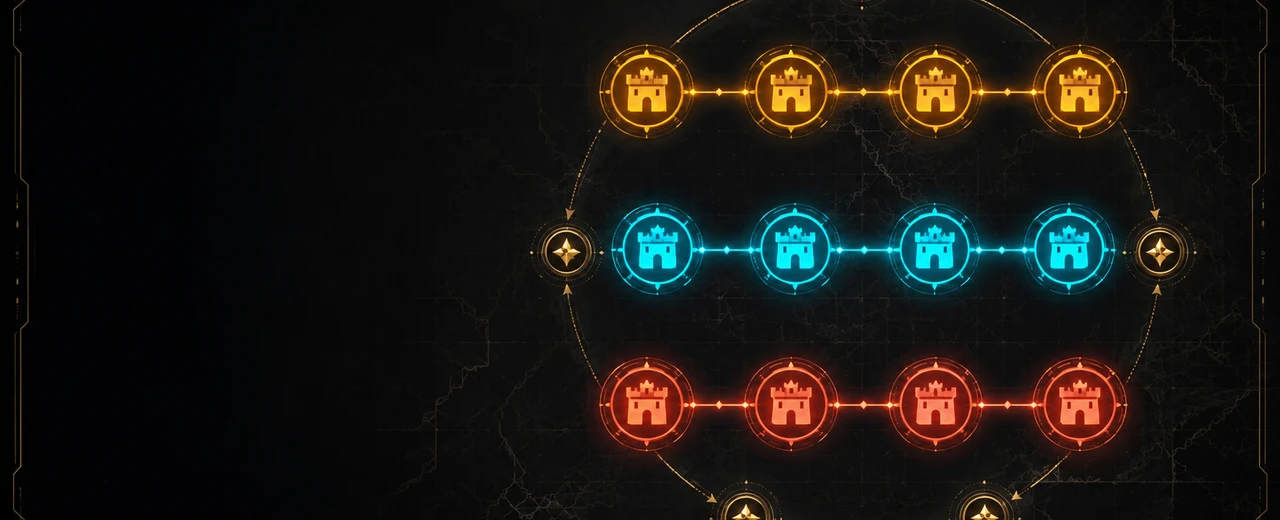
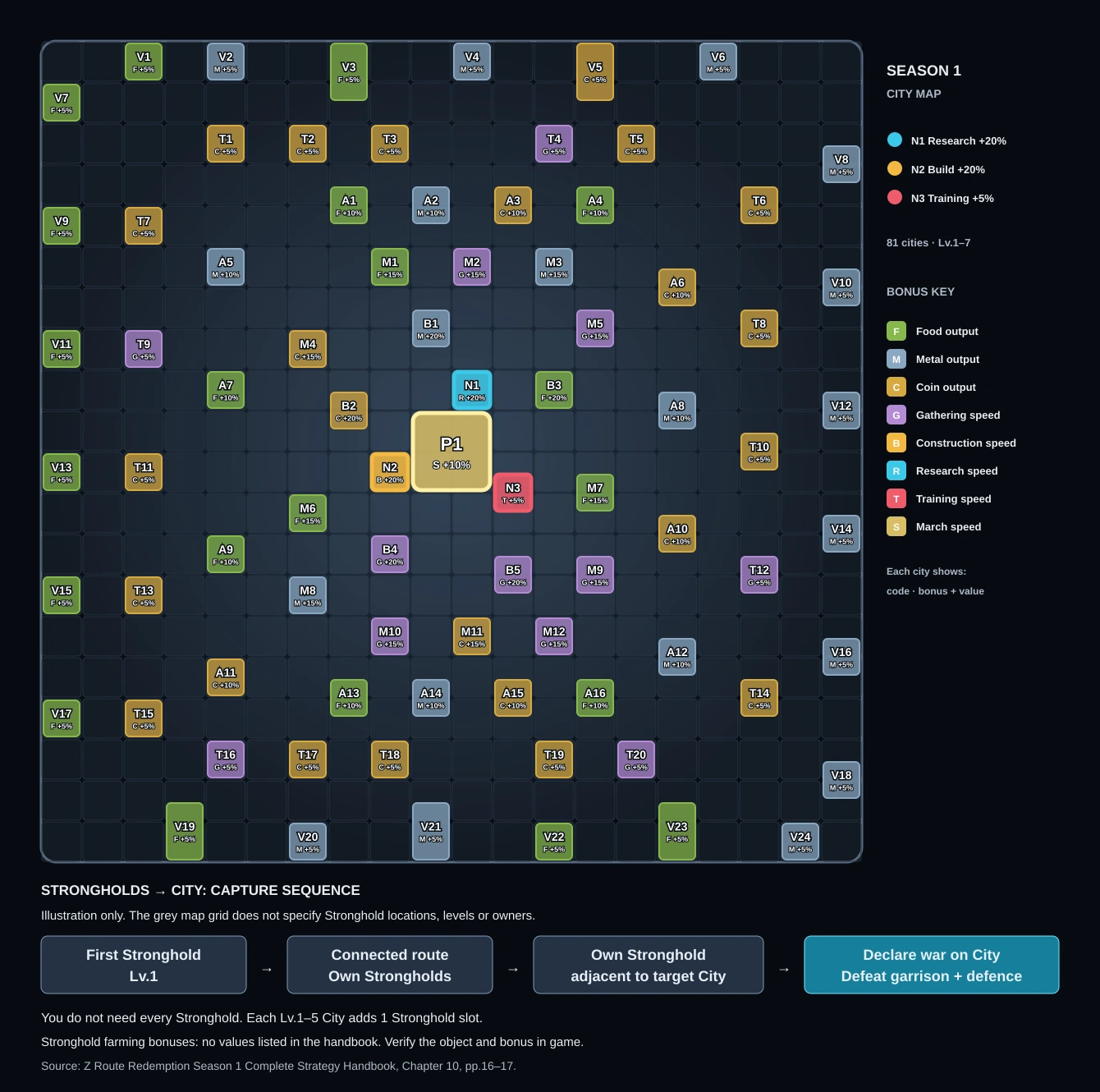
No alliance gains permanent rights from taking cities early or from holding a rank for only a few days. The city-rotation proposal is the working basis: complete connected chains, premium rotation for the Top 10, a training chain for ranks 11–15, and rankings fixed for each five-week cycle with Expedition Madness setting priority inside a group.
A fair 1×1 may happen only by mutual agreement and council approval; it cannot cancel an already published rotation. Existing borders remain until the first ratified cycle begins. Early holders and clicker operators deserve recorded recognition, but that contribution is not a permanent ownership claim.
NAP15 and disputes
NAP15 is a non-aggression pact among the current Top-15 alliances and protects their members; it does not automatically cover every S88 account. It forbids planned attacks, burning and robbery between protected members. “Robbery” means knowingly taking another protected member’s resources or rewards by attacking their base or resource tile, or by pillaging their Train or Special Ops. Only announced combat events and mutually agreed duels are exceptions.
A misclick or confusing event incident is not automatically a NAP15 violation: stop, report it and return or compensate losses where possible. Intent, scale and repetition matter. A personal dispute follows player → R4/R5; a major unresolved conflict between alliances goes to the Server Court. Retaliation and collective punishment are prohibited while a case is reviewed.
Server defense
Participation in capital defense and cross-server attacks is expected, but nobody is punished automatically for one absence, a day off or real-life obligations. Contribution may be fighting, reinforcing, operating the clicker, coordinating or supplying resources. Only repeated alliance-level refusal after a clear written request may affect next-cycle priority, and only after Council review.
Proportionate sanctions
Sanctions correct harm and prevent repetition; they are not a tool for revenge or political pressure.
-
1
Repair first
For an accident or first minor incident: stop, acknowledge it, return what can be returned and compensate verified losses where practical.
-
2
Written warning
A confirmed first violation is recorded for 30 days so repeated behavior can be distinguished from a one-time mistake.
-
3
Short minister restriction
An intentional or repeated violation may suspend minister access for 3 days; another confirmed violation within 30 days may raise this to 7 days.
-
4
Severe coordinated harm
Mass burning or a leadership-directed NAP breach triggers an immediate ceasefire, compensation and Council review. A 7-day restriction may be extended up to 14 days by a 7-of-10 vote. NAP protection is not removed automatically.
No routine 2–3 week penalty, no automatic sanction for chaotic event mistakes or one defense absence, and no punishment without evidence and a chance to respond. Sanctions target the responsible player; an alliance is liable only if its leadership approved the action or refused a reasonable remedy.
Transition while rankings change
Once ratified, the first cycle starts on a published date after capital-readiness and city-handover checks. A ranking change during the cycle takes effect only in the next cycle. Until ratification, current control remains unchanged and no side should make an irreversible redistribution. Historical service should be credited separately, not converted into permanent legal advantage.
Questions still requiring a vote
These details should remain visibly open instead of being presented as agreements that do not yet exist.
- Should the server ratify the proposed five-judge, ten-week Court and allow one appeal, or choose a different fixed size, term or appeal rule?
- What exact test proves primary and backup clicker readiness, and which qualified alliance takes the first capital term?
- Should an agreed 1×1 result ever influence next-cycle priority, or should Expedition Madness remain the only contribution tiebreaker?
The balancing principle
Past work earns respect, present strength earns responsibility, and neither creates permanent ownership. Stable cycles protect planning; equal Top-10 votes create legitimate rules; Top-3 execution enables fast action; an independent fixed-term Court prevents either council from judging its own conflicts; and evidence-based, short sanctions protect peace.
Terms and abbreviations
Select a highlighted term in the document to jump to its plain-language definition here.
- NAP15
- The non-aggression pact among the current Top-15 alliances. It protects their members under the limits and exceptions stated in this charter.
- Top-3 Operations Council
- The executive group formed by the three highest-ranked alliances for the active five-week cycle. It coordinates urgent operations and implements Council decisions.
- Top-10 Council
- The legislative body formed by the ten highest-ranked alliances for the active five-week cycle. Each alliance has one equal vote.
- Top-15 alliances
- The alliances currently ranked 1 through 15. This ranking group determines participation in NAP15.
- Top 16–20
- The alliances ranked 16 through 20. In the city proposal, they retain access to useful lower-level cities outside the three strategic rotation chains.
- R4/R5
- Alliance leadership ranks: R4 officers and the R5 alliance leader. Personal disputes are escalated through them first.
- Clicker
- The capital automation that removes the current minister once per minute so the next player already waiting in the queue can receive the appointment. It does not create the queue.
- Expedition Madness
- The cross-server competition used to set priority within a city-rotation eligibility group; Alliance Power determines the group itself.
- 1×1
- A direct contest between two alliances that happens only by mutual agreement and with Council approval.